
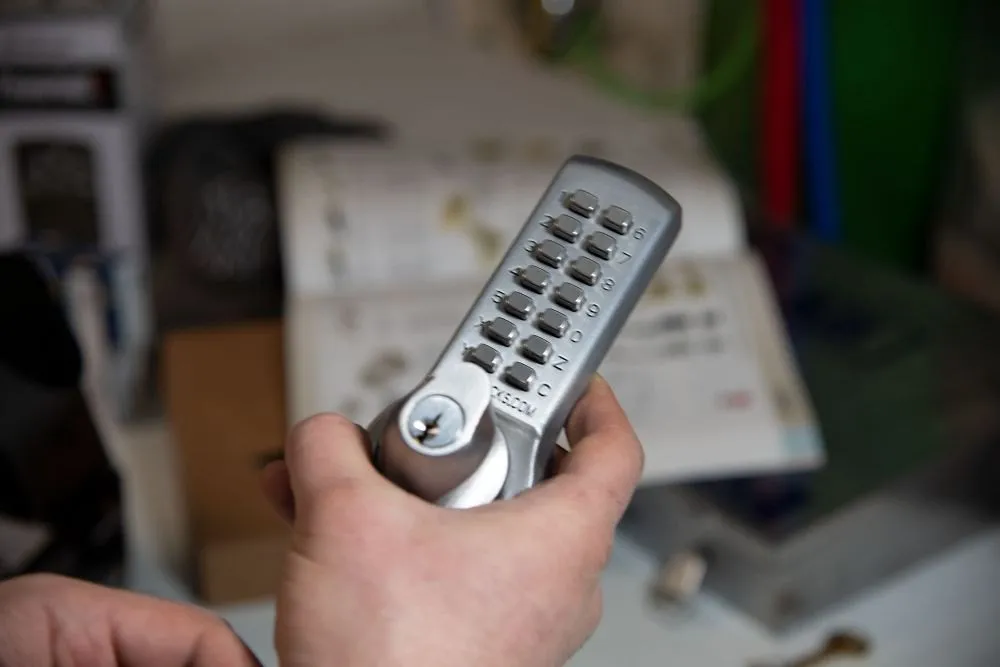




A code set in the lock itself. No wiring, no software.
A side door, a stock room, an employee entrance: openings used by people who shouldn’t be carrying a key to the building. So a key gets cut anyway, or it lives on a hook, or it gets loaned at the start of a shift and nobody can say where it went. The lock is secure in theory and open in practice.
A mechanical keypad lock holds the code in its own mechanism. Pressing the buttons in the right order moves a train of parts inside the lock, and that movement retracts the latch. The combination is the arrangement of those parts, so changing it means opening the lock and resetting them. There is nothing to wire, nothing to charge and nothing to program: there is no circuit in it.
These locks suit the openings you want controlled without keys changing hands: side doors, stock rooms, interior offices, employee entrances. Installation is locksmith work: the lock has to sit on the door properly, code access has to be set up cleanly, and the latch and alignment get checked, because a keypad lock gets blamed for a door that never closed squarely.
A code is only as private as the people carrying it. Everybody at that door works from the same code, the lock keeps no record of who went through, and changing it means visiting the lock and telling them. If you need access issued and withdrawn person by person, that is a commercial smart lock. If the latch is worn or the door has dropped, no keypad fixes that: it is lock repair or new door hardware.
Where we do this work
- Offices
- Storefronts
- Restaurants
- Apartment & condo properties
- Warehouses
- Medical facilities
- Multi-tenant buildings
What’s included
-
Mechanical keypad locks installed on commercial doors
Code entry on the openings where keys shouldn’t be circulating.
-
No electricity and no software
Nothing to wire, nothing to charge, nothing to update, nothing to fail when the power goes.
-
Code access set up cleanly
The combination set at install, and reset when who uses the lock changes.
-
Lock fitted to the door properly
The right keypad lock for the opening, mounted to suit how the door is hung.
-
Latch and alignment checked
The parts the keypad lock depends on, looked at so it keeps working smoothly long term.
-
Service on what’s already there
An existing keypad lock adjusted, repaired or recombinated rather than replaced by default.
Triggers
When a lock needs a code, not a key
Mechanical keypad locks come up when an opening needs controlling but you don’t want a key in circulation, and you don’t want anything to maintain either.
-
Keys keep changing hands at a side door
Shift workers, deliveries, cleaners: every handover is one more copy out in the world.
-
Your stock room is propped open because nobody wants to hunt for the key
The convenience always wins, so the door has to be convenient and closed.
-
You want a lock that still opens when the power is out
A mechanical code doesn’t care about the building’s electrical state.
-
You’d rather not have one more thing to administer
No batteries, no updates, no software, no account.
FAQ
Keypad locks, the questions we actually get.
Don’t see yours? Call (857) 327-1767
What does a mechanical keypad lock cost?
It depends on the door and the lock it takes: a hollow metal interior door with standard prep is a straightforward fitting, an aluminum storefront door with narrow stiles is not. The count of locks matters more than anything else on a multi-door job. Common commercial hardware is usually available and narrow-stile or less common hardware is ordered in, which is mostly what decides whether a lock is done on the visit or on a second one. You’ll get the scope and the price up front, with no hidden fees, and nothing gets ordered that the opening does not need.
Can the code be changed later?
Yes. The combination is mechanical, so it is changed at the lock by resetting the parts that hold it, not from a screen. That means a code change is a visit to the lock and a conversation with everyone who uses it, which is worth planning for if you expect to change it often.
How secure is a code that everyone at the door knows?
It depends entirely on how the code is handled, and that is the honest weak point of the product. Buttons wear and start to show which ones get pressed, people get watched opening the door, and a code stays with everybody who has ever used it until somebody changes it. Treat it as a key you cannot collect back: change it when the people using the lock change, and put it on the openings where that is a reasonable thing to manage.
Does it work during a power outage?
Yes, and that is the whole point of the product. There is no power supply, no battery and no board, so an outage, a tripped breaker or a dead circuit changes nothing about how the lock opens. It is the reason these locks end up on doors that have to stay usable no matter what else in the building has stopped.
Will one work on an exterior door through a Boston winter?
Plenty of mechanical keypads are made for exterior use, and with no battery and no board there is nothing in one for the cold to flatten or shut down. What weather reaches is the mechanism: grease stiffens as the temperature drops, water that works into a lock and freezes stops it, and a door that swells or shifts with the season drags the latch the keypad has to retract. So an outside door wants a lock meant for outside, mounted where it is not taking the worst of the weather, kept to the lubricant the lock is built for, and hung square.
Will it tell me who opened the door?
No. A mechanical keypad has no electronics and therefore no record of anything: anyone with the code is anonymous to the lock. If you need to issue and withdraw access person by person, that is a commercial smart lock, which is a different product on a different principle.
Can this be installed outside business hours?
Yes. We work 24/7 across Boston and the surrounding 30-mile area, so a locksmith can fit a keypad lock on an employee entrance or a stock room before opening rather than during the shift that depends on it.
Emergency
Break-in, failed lock, or locked out?
When your property’s security is compromised, our emergency locksmiths respond immediately to repair locks, replace compromised cylinders, and restore reliable operation.
- Commercial Lockouts
- Break-In Lock Repairs
- Emergency Cylinder Replacements
- 24/7 After-Hours Response
Request a quote
Request a quote
Our client services team is standing by to assist with locksmith services, lock changes, high-security hardware, master key systems, lock repairs, rekeying, and emergency security dispatch!
- Hours
- Monday – Sunday: 24/7 Service
- Service area
- Boston and surrounding 30-mile radius
Fully insured by Hiscox
- Google rating
- Verified Screened professionals
- Hiscox Fully insured
- Transparent pricing No hidden fees