
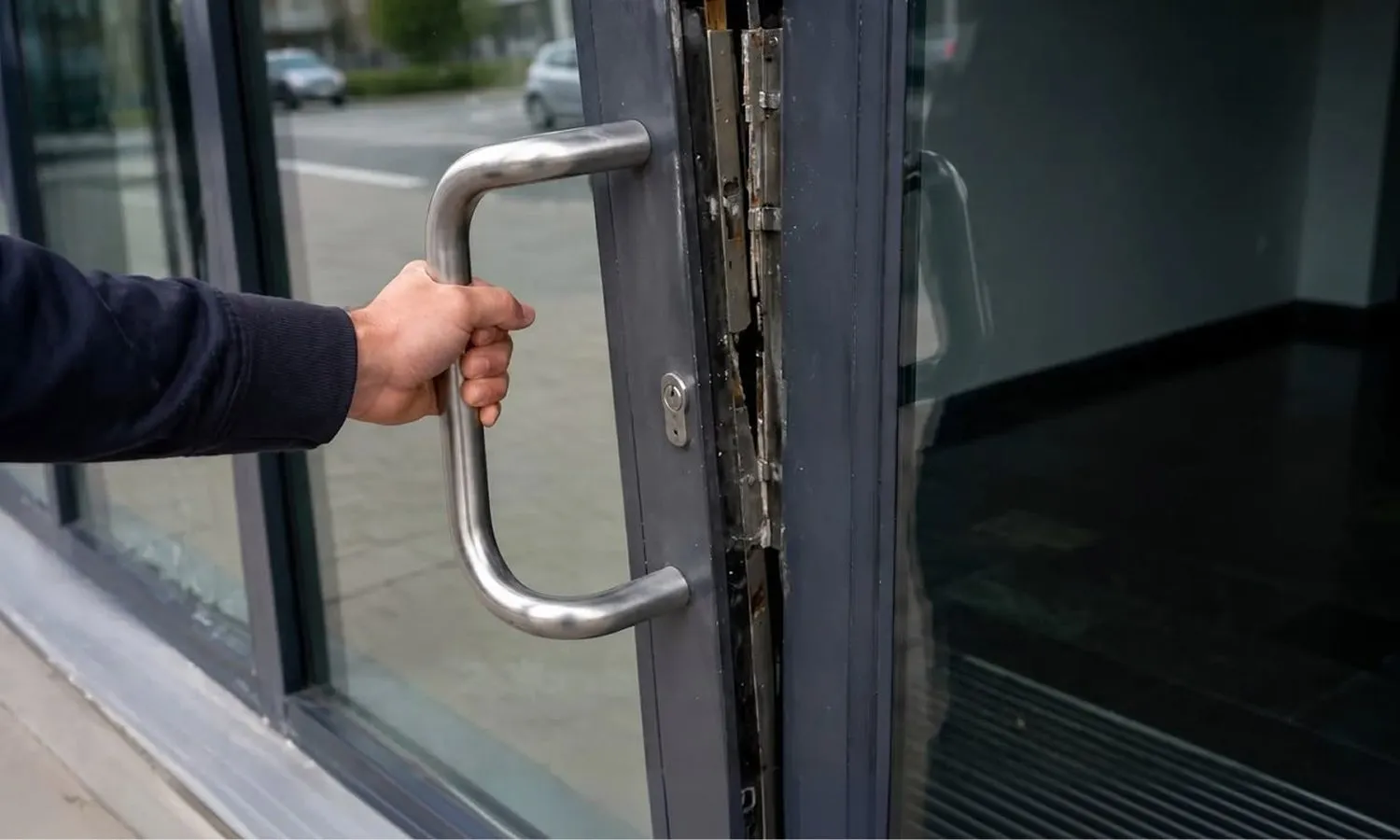




Storefront locks fail when the door around them moves.
A storefront entrance gets opened every few minutes by people not thinking about it. Then the lock stops latching. Staff learn to lean on the glass while they turn the key, and a week later locking up takes two hands. Nothing looks broken: the glass is fine, the frame looks straight, the lock turns. The door has dropped.
An aluminum storefront door does not hang on hinges. It turns on a top and bottom pivot, so its weight rides on one point at the sill. As the bottom pivot wears, the door settles and racks, and the lock’s latch stops arriving where the strike is: it catches the lip instead of passing it. Closers on glass entrances fight wind load, and an over-adjusted one makes the door slam or stall halfway, so the lock never gets the chance to catch.
As locksmiths we measure the entrance in its opening before adjusting anything: the gap down the lock stile, the gap at the head, how the door meets the threshold. The work from there is pivots, closer adjustment, strike position, and bringing the door back to square so the lock lands where it should. Scope and price are agreed before anything comes apart. Across a property, the busiest lock is the one already failing.
Here is the part nobody can tell from the sidewalk: whether the door or the lock is at fault. The complaint is identical either way, the storefront will not lock. A worn narrow-stile deadlock and a door that has dropped an eighth of an inch feel the same from the handle, so that is what gets diagnosed on site. Storefront lock hardware is its own subject, a bent or rusted frame is another, and broken glass is a glazier’s trade rather than a locksmith’s.
Where we do this work
- Offices
- Storefronts
- Restaurants
- Apartment & condo properties
- Warehouses
- Medical facilities
- Multi-tenant buildings
What’s included
-
Pivots
Top and bottom pivot sets reset or replaced, so the door carries its weight where it was meant to and the lock lines up again.
-
Hinges
Offset and continuous hinge arrangements serviced on storefront entrances hung that way rather than on pivots.
-
Closers
Adjusted so the door closes and the lock latches on an entrance that takes wind, and replaced when adjustment has run out.
-
Strikes
Strike position corrected so the lock’s latch and bolt enter the keeper instead of riding its lip.
-
Alignment
The door brought back to square in its opening, with the gaps evened top to bottom along the lock stile.
-
Heavy-traffic entrances
Storefronts cycled hundreds of times a day, where a lock adjustment holds only if what caused the drop is addressed.
Triggers
When a storefront lock stops latching
On an aluminum storefront, most of this gets reported as a lock problem first, and a locksmith is the one who can tell which part it is.
-
The lock only catches if somebody pulls or lifts the door
The latch and the strike are no longer meeting on their own.
-
The door drags on the threshold, or catches at one corner
A storefront turning on worn pivots drops and leans rather than sagging like a hinged door, and takes the lock with it.
-
The door slams, or stops halfway and the lock never engages
A closer set against wind load on a glass entrance, usually turned up to cover for something else.
-
The lock was replaced and the storefront still will not lock
New hardware went into the same geometry, and the geometry is what moved.
FAQ
Storefront locks, the questions we actually get.
Don’t see yours? Call (857) 327-1767
Is it the door or the lock?
That is the honest question, and it is the one a customer cannot answer from outside. A sound narrow-stile deadlock in a door that has dropped behaves exactly like a failing lock: the key turns, the bolt moves, and the storefront still will not secure. We check the door in its opening first, because if the geometry moved, a new lock lands in the same place the old one did.
Is there anything I can check before I call the locksmith?
Yes, and two minutes of looking usually tells us more than the complaint does. Stand inside and look at the gap down the lock stile from top to bottom: on a square door it stays even, and on a dropped one it closes up at the bottom and opens at the top. Then watch the bottom of the door as it swings, because a storefront that scuffs the threshold or catches at one corner is riding on a worn pivot. Note whether anyone has to lift or pull before the lock catches, since that is the plainest sign the latch is no longer reaching the strike on its own.
This storefront was adjusted a few months ago and the latch is missing the strike again. Why?
Usually because the adjustment squared the door up while the worn part stayed where it was. A bottom pivot carries the entire weight of the door, so once it is worn the storefront keeps settling and any lock alignment set against that position goes out again. The other repeat cause is how the entrance gets used: a door pulled open by the glass rather than the handle, or propped back past its swing, works the pivots and the closer arm every time it happens. We look for what moved the door before moving it back.
Is adjusting the storefront cheaper than replacing it?
Usually, and usually it is also possible: pivots, a closer and a strike are serviceable parts, and squaring the door in its opening is hand work with the door in place, so you keep the storefront and the lock you own and pay for labor plus what actually wore out. That stops being true when the door has racked past straightening or the opening has moved with the building, which is a different job with a different scope. We will tell you which of those you are looking at rather than selling an adjustment that will not hold. Either way the price is quoted up front, with no hidden fees.
The glass is cracked as well. Can you take care of that?
Glass is a glazier’s trade, not a locksmith’s. What belongs here is the lock and everything it depends on: the door and its stiles, the top and bottom pivots, the closer, the strike and the lock itself. A cracked or broken pane is cut, handled and set by people who do that work all day, and it is worth calling one rather than waiting to find out whether we can. If both have gone on the same entrance, we will tell you plainly which part of it is ours.
What if the storefront needs a part? Can the entrance still be locked?
Common storefront hardware, pivot sets, closers and strikes among it, is the kind of part that is usually available, and that work is done with the door in place. Narrow-stile lock hardware and less common parts are ordered in, and when that is the case the entrance is made as secure as the lock allows and the permanent repair follows on a second visit. Which of those you are in gets said on site, with the scope and the price agreed before anything comes apart. Bringing a racked door back to square takes longer than either, and a storefront that turns out to need replacing is a separate job.
Can a locksmith come out after hours?
Yes. We work 24/7 across Boston and the surrounding 30-mile area. A storefront lock that will not catch at closing time is worth calling about at the hour it happens, not the next business day.
Emergency
Break-in, failed lock, or locked out?
When your property’s security is compromised, our emergency locksmiths respond immediately to repair locks, replace compromised cylinders, and restore reliable operation.
- Commercial Lockouts
- Break-In Lock Repairs
- Emergency Cylinder Replacements
- 24/7 After-Hours Response
Request a quote
Request a quote
Our client services team is standing by to assist with locksmith services, lock changes, high-security hardware, master key systems, lock repairs, rekeying, and emergency security dispatch!
- Hours
- Monday – Sunday: 24/7 Service
- Service area
- Boston and surrounding 30-mile radius
Fully insured by Hiscox
- Google rating
- Verified Screened professionals
- Hiscox Fully insured
- Transparent pricing No hidden fees