
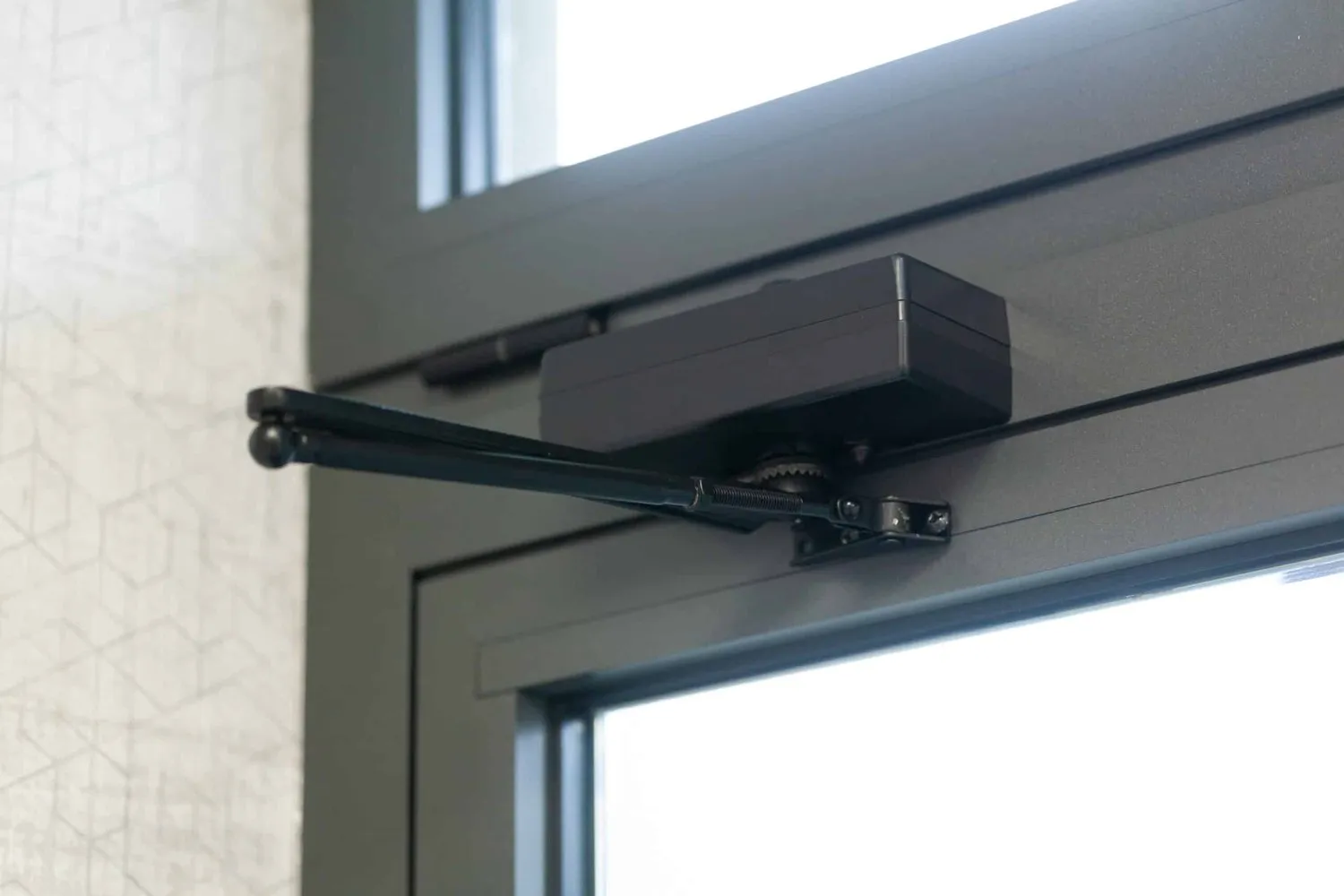




Four adjustments, and almost every complaint is one of them.
Nobody calls a locksmith about a closer. They call because the back entrance slams hard enough to rattle the glass, because the front lock never catches and the door stands open an inch all afternoon, or because the swing is long enough to dent the wall behind it. Three complaints, one piece of hardware above the lock, and usually nothing inside it is broken.
A closer is a spring in an oil-filled body, with a separate adjustment for each stage of the cycle. Sweep speed governs the long swing from open to a few inches out. Latch speed governs that last stretch, where the door needs just enough momentum to throw the lock’s latch into the strike. Backcheck cushions the opening arc so the door cannot be flung into the wall. Spring force sets how hard it pushes closed.
The first move is to read the symptom. A slam is latch speed. A door that stops an inch short of the latch is spring force, or a door dragging on something. A swing that flies into the wall has no working backcheck. Scope runs from one adjustment above one lock to every closer on a property, where a lobby entrance and a stockroom door want different settings.
Adjustment has a limit. When the seals go, the body weeps oil down the face of the door, and turning the screws will not bring that unit back: it gets replaced. The other limit is the opening itself. A closer fighting a dragging door or a racked frame is doing work no closer is sized for, and it will fail early, taking the lock’s alignment with it. That is lock and frame repair.
Where we do this work
- Offices
- Storefronts
- Restaurants
- Apartment & condo properties
- Warehouses
- Medical facilities
- Multi-tenant buildings
What’s included
-
Sweep speed
The long part of the swing set so the door closes at a pace people can walk through, not one they have to wait out.
-
Latch speed
The last inch tuned so the lock’s latch throws every time without the door announcing itself to the whole floor.
-
Backcheck
The opening arc cushioned so a gust or a shove stops the door before the wall, the handrail or the hinge takes it.
-
Closing force
Spring tension matched to the weight of the door and to what the opening has to fight, so the lock catches under its own power.
-
Surface closers
Installed and replaced on the face of the door or the frame, sized to the opening rather than to the hole left by the old one.
-
Concealed closers
Units hidden in the frame head or in the floor, serviced or swapped where the entrance is meant to show no hardware at all.
Triggers
When a door stops closing and the lock stops catching
Every one of these gets described as a broken closer or a failing lock, and most of them are a setting a locksmith can reset.
-
The door slams
It is loud, it is hard on the frame and the lock, and it is the one adjustment people most often try to fix by tightening something.
-
The door stops an inch short and the lock never catches
The lock is fine. Nothing ever reached it, so the entrance sits unsecured all day.
-
The door swings back into the wall
A dent in the drywall, a bent arm, or a hinge taking a load it was never meant to take.
-
There is oil on the face of the door or a wet patch on the floor
A closer that is leaking is spending its fluid, and it will not adjust back to health.
FAQ
Closers, the questions we actually get.
Don’t see yours? Call (857) 327-1767
Can my closer be adjusted, or does it need replacing?
Most of them adjust. If the body is dry on the outside and the arm is straight, the complaint is usually one valve out of range and that is labor and no parts. A unit that is leaking oil, seized, or mounted with its screws pulled out of the door is a replacement, and we will say which one you have before anything is ordered. Either way the price is quoted up front, with no hidden fees.
Can I adjust it myself?
You can, carefully, and it helps to know what you are turning. Most closers carry small valves on the body marked for sweep and latch, and they work in fractions: an eighth of a turn, then swing the door and see whether the lock catches. The one to leave alone is a valve that is already backed well out, because a valve wound past its thread lets the fluid out and ends the unit there and then. Closing force is set at the arm and the spring rather than at a valve, and getting that wrong leaves a lock that will not latch at all.
The door closes slowly in winter and slams in summer. Is the closer broken?
Probably not. The fluid in a closer thickens in the cold and thins in the heat, so an exterior entrance set perfectly in July can drag in January and leave the lock short of the strike. On most units that is a small seasonal change to the sweep valve rather than a new closer. A closer that only works in one season, no matter how it is set, has usually lost its fluid.
You just replaced my closer and the latch is missing the strike again. Why?
Because the closer was probably the symptom. A door that has dropped on its hinges, or a frame that has racked out of square, makes the closer push uphill into a strike that has moved. A new unit in that opening wears out the same way the last one did. Fixing the geometry is what makes the closer last and the lock catch, and on aluminum storefront locks the pivots and hardware are a separate subject again.
How often should closers be looked at?
There is no interval that applies to every building, but as general guidance most properties look at their locks and closers once or twice a year, and more often on the openings that take the traffic. A closer shows strain before the rest of the opening does, so looking at one is really looking at the whole lock side: hinge screws, the gap along the lock edge, and whether the latch is entering the strike. We adjust closers above locks we did not install, which is most of the work. Where the same entrance keeps costing you a service call, upgrading the component that keeps failing is often cheaper than adjusting it again.
Can a closer be added to a door that never had one?
Usually, and the questions are where it mounts and what it mounts into. A closer can sit on the pull side of the door, on the push side with the arm running parallel to it, or up on the frame head, and the swing, the clearance above the opening and what is behind the wall decide which of those works. The part people do not expect is backing: the body and the arm shoe have to fasten into solid material, so a hollow door or a light frame may need reinforcement before anything goes on. Once it is on, the door reaches the lock every time.
Can a locksmith come after hours?
Yes. We work 24/7 across Boston and the surrounding 30-mile area. A closer that has stopped pulling the door shut leaves a lock that never catches and an entrance standing open, which is worth a call at the hour you notice it rather than the next business day.
Emergency
Break-in, failed lock, or locked out?
When your property’s security is compromised, our emergency locksmiths respond immediately to repair locks, replace compromised cylinders, and restore reliable operation.
- Commercial Lockouts
- Break-In Lock Repairs
- Emergency Cylinder Replacements
- 24/7 After-Hours Response
Request a quote
Request a quote
Our client services team is standing by to assist with locksmith services, lock changes, high-security hardware, master key systems, lock repairs, rekeying, and emergency security dispatch!
- Hours
- Monday – Sunday: 24/7 Service
- Service area
- Boston and surrounding 30-mile radius
Fully insured by Hiscox
- Google rating
- Verified Screened professionals
- Hiscox Fully insured
- Transparent pricing No hidden fees