
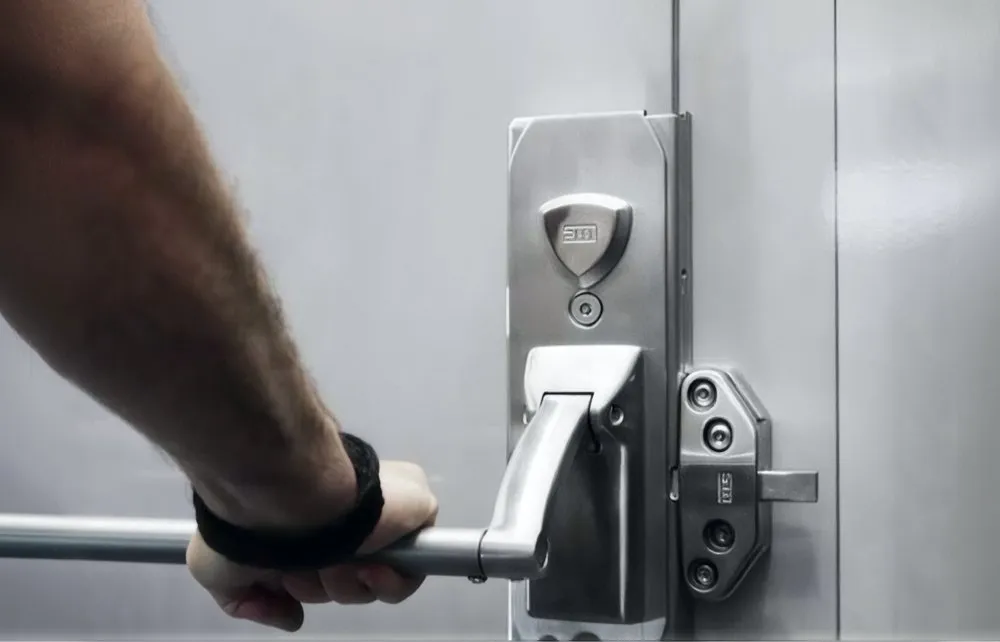



Engineered against the ways a lock actually gets beaten.
Most commercial doors carry whatever lock the building came with, chosen for the opening rather than for what sits behind it. A standard cylinder is a stack of five or six pins, and a practiced hand can set them one at a time until the plug turns; a drill bit in the right spot ends it sooner. For an interior office that is an acceptable risk. On a stock room, a cash office or a records room it is not.
High-security locks answer each of those attacks with a specific piece of engineering. Pick resistance comes from tighter tolerance plus a second condition the key has to satisfy before the plug turns at all: a sidebar, rotating pins, a slider, so setting the pins alone frees nothing. Drill resistance is physical rather than clever: hardened steel inserts in the cylinder body and the plug, so a bit skates off instead of cutting a path.
A patent-protected keyway is different again. The key profile itself is controlled, so blanks are not sitting in a bin at a counter, which is where attack resistance ends and key control begins. Our locksmiths install, repair, rekey and upgrade these locks, on one opening or across a property. Across a property the question is which openings carry enough exposure to earn the cost, and where the building is already keyed to a plan, high-security cylinders can be brought into it.
The limit is worth saying plainly, because it belongs as much to the frame as to the lock. A cylinder in a hollow door, a split frame or a misaligned opening buys less than it looks like: an attacker goes around the lock rather than through it, and a thin strike on short screws comes out under a pry bar whatever the cylinder cost. If the door or the frame is the weak point, repairing that comes first.
Where we do this work
- Offices
- Storefronts
- Restaurants
- Apartment & condo properties
- Warehouses
- Medical facilities
- Multi-tenant buildings
What’s included
-
New high-security installs
The right cylinder or lock body fitted to the opening it has to protect.
-
Upgrades from standard hardware
Keeping the door and the function, raising what it takes to defeat the lock.
-
Rekeying high-security cylinders
New keying on hardware you already own, without replacing it.
-
Repair of existing high-security locks
Worn, sticking or damaged hardware put back into proper operation.
-
Medeco, Mul-T-Lock, Yale and others
We work with these and with other professional commercial systems, chosen per opening rather than by habit.
-
Entry-point evaluation
Which openings justify high-security hardware, and which are better served by something simpler.
Triggers
When standard hardware stops being enough
High-security locks are usually a response to one specific opening, not to a whole building at once.
-
Someone has already tried this lock
Tool marks at the keyway, a scratched cylinder face, a strike that was pried and never recovered.
-
One room holds far more than the rest of the floor
Stock, cash, records, controlled supplies, equipment that cannot be replaced by Friday.
-
The lock is builder-grade and the risk is not
Hardware that was fine when the room held files and is wrong now that it holds stock, a server rack or a cage in a warehouse.
-
Your insurer or your tenant has asked what protects that opening
A question that is easier to answer when the lock was chosen for the opening rather than inherited with it.
FAQ
High-security, the questions we actually get.
Don’t see yours? Call (857) 327-1767
How much more do high-security locks cost than standard ones?
More, and the gap is real: you are paying for machining tolerance, hardened inserts and a controlled key profile, none of which exist in builder-grade hardware. What changes the number most is whether the opening takes a cylinder swap or a whole lock body, and how many locks are involved. The price is quoted up front, with no hidden fees, so the comparison with standard hardware is one you make before any work starts.
Can a high-security lock be rekeyed, or do I need a new one?
It can be rekeyed. The cylinder is re-pinned much like any other, with one difference: the key profile is controlled, so the keys come through a restricted channel rather than from a generic blank cut at a counter. That is worth planning a step ahead of a staff change rather than during one.
How do we get extra keys once the hardware is in?
Not from a counter, which is the point of a controlled key profile. Blanks for these systems are not sold openly, so an additional key comes through the system itself: the order is placed by the authority the system was set up with, checked against it, and cut on that controlled blank rather than off a rack while you wait. That is worth doing ahead of a hiring round or a tenant move-in rather than in the middle of one. Who holds that authority, and who is allowed to use it, is key control, and it is covered on restricted key systems.
Do I have to replace the whole lock?
Often not. Many commercial openings use a mortise or rim cylinder that threads into the lock body, so the body, lever and trim stay and only the cylinder changes. Where the existing lock body is the weak point, or the door was never prepared for the function you need, replacing the unit is the honest answer, and we will tell you which case you are in before anything is ordered or cut. High-security hardware is not the stock a counter carries, so it is ordered in for the opening it has to protect, and where a door cannot be left open in the meantime it is secured as the opening allows until the permanent work goes on.
Will a high-security lock stop a break-in?
It removes the easy ways in, picking and drilling, and it makes the lock the hardest part of the opening rather than the softest. It does not make a hollow door solid or a bent frame straight. Forced entry usually goes around the lock rather than through it, by way of the frame, the strike or the glass, which is why we look at the whole opening before recommending a cylinder.
Should every door in the building have one?
Usually no, and we will say so. High-security hardware earns its cost on openings with real exposure behind them. On the rest, a sound commercial deadbolt, correct alignment and sensible keying do more per dollar, and it is better to protect the few openings that matter properly than every door indifferently.
Can you do this outside business hours?
Yes. We work 24/7 across Boston and the surrounding 30-mile area, which matters here more than on most jobs: an upgrade on a main entrance is easier at 5am than at noon, and a door that was attacked overnight does not have to stay that way until morning.
Emergency
Break-in, failed lock, or locked out?
When your property’s security is compromised, our emergency locksmiths respond immediately to repair locks, replace compromised cylinders, and restore reliable operation.
- Commercial Lockouts
- Break-In Lock Repairs
- Emergency Cylinder Replacements
- 24/7 After-Hours Response
Request a quote
Request a quote
Our client services team is standing by to assist with locksmith services, lock changes, high-security hardware, master key systems, lock repairs, rekeying, and emergency security dispatch!
- Hours
- Monday – Sunday: 24/7 Service
- Service area
- Boston and surrounding 30-mile radius
Fully insured by Hiscox
- Google rating
- Verified Screened professionals
- Hiscox Fully insured
- Transparent pricing No hidden fees