
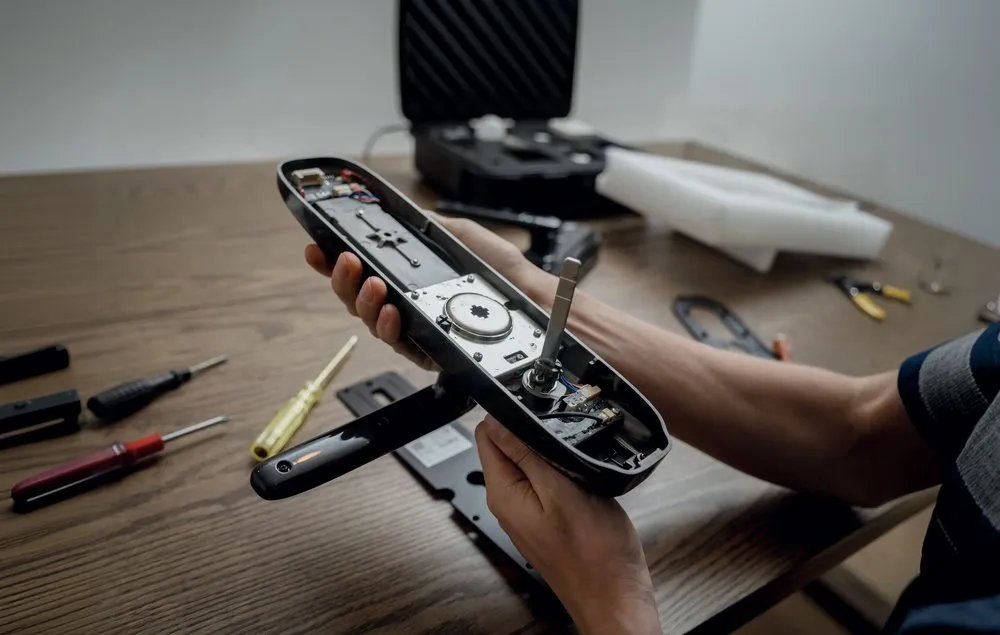




Most locks are repairable. Some are not, and we will say which.
Locks almost never fail all at once. They get harder. The key that used to turn with two fingers now needs a wiggle and a lift. The deadbolt throws most of the way and then stops, so somebody starts pulling the door toward them to lock up at night. Staff work around it for weeks, and then one morning it doesn’t work at all, usually on the busiest door in the building.
What wears out is small and specific. Inside a cylinder, brass pins and springs ride against the key hundreds of times a week, and grit carried in on keys grinds both. Outside it, latch springs weaken so the bolt no longer snaps fully out, cams develop play and the lever droops. Most of that is repairable: re-tension a spring, re-pin a cylinder, true up the strike, and the door works again.
Replacement is the better call when the body itself is worn through, when the lock has been forced, or when the parts needed add up to most of a new lock. We say which of those we are looking at before any work starts. Scope runs from one lock to a whole property, where consistency matters: matching hardware so every lock behaves the same way, picking the right deadbolt for the traffic that opening takes, moving to high-security hardware where the exposure behind the lock justifies it, and keying anything new to the key you already carry.
Sometimes new hardware is simply the wrong answer. If the lock is sound and what changed is only who holds a key, you want rekeying: the cylinder is re-pinned and every old key stops working. And a lock that binds is often not a lock problem at all: hinges sag, frames shift, and the latch catches the lip of the strike instead of entering it, so replacing the lock pays for a symptom. When the door or the frame has dropped, that is the repair to make first.
Where we do this work
- Offices
- Storefronts
- Restaurants
- Apartment & condo properties
- Warehouses
- Medical facilities
- Multi-tenant buildings
What’s included
-
Worn-out locks
Cylinders and latches that have been ground down by daily use, repaired or replaced.
-
Damaged locks
Hardware that has been forced, struck or broken, assessed for what is still sound.
-
Locks that are difficult to operate
Sticking keys, drooping levers, deadbolts that won’t throw cleanly.
-
Hardware assessment first
We look at the lock, the latch and the strike, then recommend the fix.
-
Replacement and proper installation
New hardware fitted and adjusted so it operates smoothly, not just mounted.
-
One lock or a whole property
A single lock, or every lock in a building brought to one standard.
Triggers
When a lock is telling you something
Most people call about a lock that still works. That is the right time, because a lock that is getting worse is cheaper to deal with than a lock that has stopped.
-
You have to jiggle or lift the key to get it to turn
It has been getting slowly worse for months, and new keys only help for a while.
-
The handle or lever moves but the latch doesn’t
The lever sags, there is play in the handle, and sometimes the door doesn’t actually latch.
-
The deadbolt won’t throw all the way
Somebody has to pull or lean on the door to lock up at the end of the day.
-
The lock has been forced or damaged
After a break-in attempt, an impact, or a key snapped off in the cylinder.
FAQ
Repair or replace, the questions we actually get.
Don’t see yours? Call (857) 327-1767
Is it cheaper to repair a lock or replace it?
It depends on what has failed. A spring, a cam, a set screw or a worn cylinder is usually labor plus a small part, which costs less than a new lock body. Once several of those parts are worn at the same time, or the body itself is gone, repair stops being the cheaper option, and we will say which situation you are in before we start. Either way the price is quoted up front, with no hidden fees.
What do you check before deciding?
The lock, and then the door. We operate the lock with and without the door closed, which separates a cylinder or latch problem from an alignment problem, and we look at where the latch is actually hitting the strike. That order matters: a lock replaced on a misaligned door starts binding again.
Can you work on the lock in an aluminum storefront door?
Yes, though it is a different family of hardware. A narrow stile leaves under two inches of aluminum to work in, so those doors carry hook bolts and deadlatches rather than the mortise and cylindrical locks fitted to steel and wood doors, and the cylinder usually threads in behind the face. If the lock itself is sound and the door is dropping on its pivots or binding at the head, what needs fixing is the door rather than the lock.
Can a new lock work with the key I already carry?
Often, yes, if the cylinder is compatible. New hardware can be keyed to your existing key so a single repair doesn’t leave staff carrying an extra key. Where the hardware isn’t compatible we will tell you what the options are.
One lock failed. Do I have to replace the rest?
No. A failed lock is a failed lock. If several locks on a property are the same age and the same model and they are all starting to drag, that is worth knowing about, but it is a decision you make with the information, not something we bundle into the job.
How long does it take, and will it be finished in one visit?
A single repair or lock swap is short work once the problem is identified, and the common commercial cylinders and lock cases are hardware that is generally available in the trade, so most of those jobs are done on the visit. Less common hardware, and the narrow-stile hardware an aluminum door takes, is ordered in: where that happens the door is left as secure as it can be and the permanent work follows. A property where doors are being brought to one standard takes as long as the door count, and you will know the scope before anything starts.
Can you come out after hours?
Yes. We work 24/7 across Boston and the surrounding 30-mile area, so a locksmith can get to a lock that fails at closing time, or a door that won’t secure overnight, without waiting for the morning.
Emergency
Break-in, failed lock, or locked out?
When your property’s security is compromised, our emergency locksmiths respond immediately to repair locks, replace compromised cylinders, and restore reliable operation.
- Commercial Lockouts
- Break-In Lock Repairs
- Emergency Cylinder Replacements
- 24/7 After-Hours Response
Request a quote
Request a quote
Our client services team is standing by to assist with locksmith services, lock changes, high-security hardware, master key systems, lock repairs, rekeying, and emergency security dispatch!
- Hours
- Monday – Sunday: 24/7 Service
- Service area
- Boston and surrounding 30-mile radius
Fully insured by Hiscox
- Google rating
- Verified Screened professionals
- Hiscox Fully insured
- Transparent pricing No hidden fees